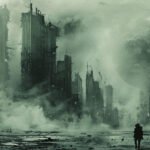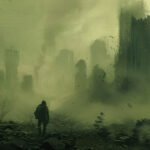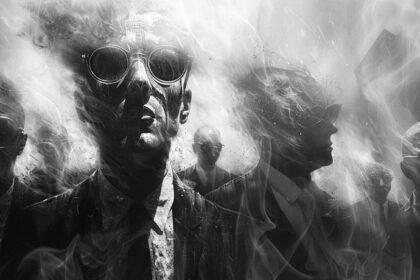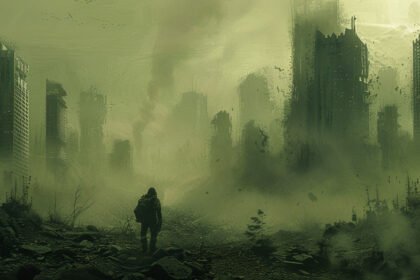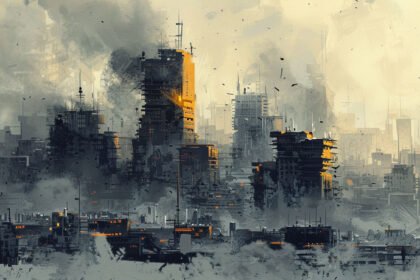


The disaster that ended old California and left Veridian City standing in its place.
Before It Broke
For most of the mid-century, California looked like the safest bet in the world. It still wrote the software, still made the films, still drew people who believed the future was a thing you moved toward rather than something that happened to you. Underneath the prosperity, two slow problems were getting worse, and almost everyone agreed to look past both.
The first was the weather. The summers ran longer and hotter every year. The fire season stopped having an end. The reservoirs dropped, the coast crept inland, and the storms that came ashore hit harder than the ones before them.
The second was the machinery. Year by year, more of the things that kept people alive had been handed to automated systems: the grid, the water, the supply lines, the markets. Each was tuned for efficiency until there was no slack left in it and no one alive who could run it by hand. Nothing about the automation was evil. It was simply too complex for any person to hold, and too lean to survive a bad day.
The First Cracks
The trouble started small enough to ignore. A grid that flickered where it never had. A water plant that lost a few hours. A shipment that arrived late, then later, then not at all. Each was written off as a glitch and patched over. None of them were connected, until all of them were.
The Cascade
It broke for good when a major grid in California took a routine fault and had nowhere to put it. The system meant to absorb the shock had been optimized down to nothing, and the failure spread instead of stopping.
- The lights went out. The first blackout overwhelmed the backups and rolled across the state. Hospitals, water treatment, and transit went dark at once.
- The lines went down. The communication networks ran on the same power and the same automation, so they failed within hours, cutting whole regions off from one another and from any help.
- The shelves went empty. With power and coordination gone, the automated supply lines stopped. Food, water, and medicine stopped moving, and the cities had only ever kept a few days of any of it.
When No One Could Fix It
The worst part was how little anyone could do. The systems built to manage a disaster were the same systems that had failed, and the override switches led back into machinery no living person fully understood. A generation of running everything through software had quietly retired the people who knew how to run it by hand. That expertise did not die in the Collapse. It had been gone for years. The Collapse was only the bill coming due.
The Land Turned Too
The weather did not wait for the cities to recover. Power stations failed dirty, spilling what they were built to contain. The storms kept coming, and one of them put the sea over the bayfront and never gave it all back. The coast that had been the most valuable ground in the world became the first thing the water took, whole districts abandoned to flood in a single season.
The Collapse
What people now call the Great Collapse was not one night. It was months of the same thing happening over and over, each failure making the next one worse, until the order everyone had trusted was simply gone. California, the place that had been the future, was a ruin.
It did not stay contained. The systems that tied the region to the rest of the world went down with everything else, and the news from outside stopped coming. For a long time no one knew what was left beyond the state line. Most of it never came back into contact at all, and that silence is the land people now call the Wilds.
What Survived
People survived the way people always do, in pockets, by luck and stubbornness. Communities that held together relearned the old skills the soft years had let them forget. They grew food on rooftops and in empty lots, married whatever salvaged machinery still ran to methods two centuries old, and kept each other alive one season at a time. It was not noble. It was only what was left.
The Rebuild, and the City It Made
Out of that, a coalition of engineers, planners, and money put forward a plan to rebuild the whole coast as one connected city instead of a thousand broken towns. Most of them meant well, and they wrote every good intention into the design: human oversight, sustainability, power shared out so that nothing could ever again be allowed to fail the way it had.
The reality cost more than good intentions could cover. The people with the capital to finish the rebuild wanted control in return, and they got it. The new city ran on a single digital credit, which made trade simple and made every transaction visible, and the visibility became a leash. By the time the lights were back on across the coast, the place had a hopeful name, Veridian, and an owner class no one had elected.
The people who had to live in it would give it the other name soon enough.